Managing safety within a single repair facility is challenging enough. Expanding those expectations across multiple locations introduces an entirely different level of complexity. Large fleets often operate through regional maintenance shops, contractor facilities, municipal yards, or distributed service centers where procedures, equipment, and training standards may vary significantly.
This inconsistency creates operational and safety risks that many organizations underestimate. Effective fleet maintenance safety protocols depend on more than written procedures—they require uniform systems, dependable equipment, and repeatable training methods that deliver the same level of protection at every location.
For fleet managers overseeing multi-site operations, standardization has become one of the most important tools for improving technician safety and operational reliability.
The Multi-Site Safety Challenge
Fleet growth naturally creates operational complexity.
As organizations expand geographically, maintenance responsibilities often become decentralized. Different facilities may develop their own repair habits, purchasing preferences, and training practices over time.
This creates uneven safety environments.
One location may maintain strict procedures and dependable truck safety equipment, while another relies on informal methods or inconsistent maintenance practices. Even small differences in repair routines can create significant exposure when technicians work around heavy equipment and raised dump beds.
Common challenges include:
- Different safety procedures between facilities
- Varying equipment quality
- Inconsistent technician training
- Uneven supervisor oversight
- Mixed maintenance documentation practices
- Variable compliance expectations
Without standardized systems, safety performance becomes difficult to control.
Why Inconsistency Creates Risk
Safety gaps often develop gradually.
A procedure modified at one location may seem harmless initially. Over time, however, these differences can lead to confusion, miscommunication, and unsafe habits.
This becomes especially dangerous during dump truck maintenance.
Raised beds, hydraulic systems, and heavy vehicle components require dependable dump bed safety support. When technicians across different facilities use varying methods or unfamiliar equipment, the likelihood of mistakes increases.
Inconsistent safety practices can contribute to:
- Human error
- Improper equipment usage
- Reduced technician confidence
- Slower repairs
- Higher incident potential
- Greater liability exposure
The problem is not simply operational—it is structural.
Standardization Is About More Than Compliance
Many organizations view standardization only through a regulatory lens.
While compliance matters, the larger value lies in operational consistency.
When technicians across multiple locations follow the same truck repair safety equipment procedures and use the same engineered systems, several advantages emerge:
- Faster onboarding
- Stronger technician familiarity
- Reduced training complexity
- Better communication
- More predictable safety outcomes
- Improved operational efficiency
Consistency reduces uncertainty.
And uncertainty is often where accidents begin.
Training Becomes Easier When Equipment Is Consistent
Training programs become significantly more effective when equipment remains consistent across locations.
Many fleets struggle because technicians transfer between facilities and encounter unfamiliar procedures or support systems.
This creates unnecessary learning curves.
When one location uses improvised supports and another uses different stabilization systems, technicians must adapt repeatedly.
Uniform truck safety products eliminate this confusion.
Technicians learn:
- One setup method
- One inspection process
- One stabilization approach
- One safety expectation
This creates stronger procedural memory and more reliable execution.
The result is better technician confidence and fewer avoidable mistakes.
Why Multi-Site Operations Need Repeatable Safety Systems
Heavy-duty repair work leaves little room for improvisation.
Hydraulic systems and raised dump beds demand physical safeguards that perform consistently regardless of location.
A fleet manager cannot personally oversee every repair bay across multiple sites.
Instead, they depend on systems that produce repeatable results.
This is why fleet maintenance safety protocols must include dependable physical equipment—not only written procedures.
Reliable truck bed locks provide:
- Predictable stabilization
- Reduced setup variability
- Clear usage expectations
- Consistent technician protection
- Stronger maintenance control
Standardized equipment creates a shared safety language across facilities.
The Operational Cost of Safety Variability
Inconsistent maintenance procedures create more than safety concerns—they create operational inefficiency.
Different methods often lead to:
- Delayed repairs
- Duplicate training
- Equipment confusion
- Slower inspections
- Communication breakdowns
- Increased oversight demands
Fleet managers frequently spend considerable time resolving preventable inconsistencies.
Standardized systems help reduce this administrative burden.
When equipment and procedures align, workflow improves naturally.
Technicians spend less time adapting and more time completing repairs safely.
How BedLock Supports Standardized Fleet Safety
BedLock Safety Products LLC addresses these challenges through engineered systems designed for consistency.
Our truck bed locks provide dependable dump truck bed safety stands that support repeatable maintenance practices across different repair environments.
Uniform design plays an important role in scalable safety.
Rather than relying on varying local solutions, organizations can establish standardized equipment usage across multiple sites.
This allows training, procedures, and inspections to remain aligned.
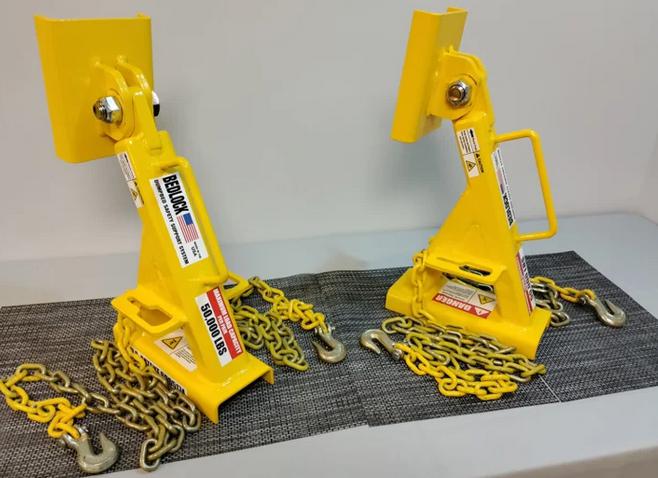
BL-400 A/B and BL-450 A/B
These systems support everyday maintenance and standard repair operations.
The BL-450 A/B offers practical deployment and dependable stabilization, making it a strong option for facilities seeking consistency in routine service work.
Because these models maintain predictable operation, training remains easier to replicate across locations.
BL-600 A/B and BL-650 A/B
Mid-to-heavy fleet operations often require stronger structural support.
These systems provide additional durability and enhanced load capability while preserving standardized deployment practices.
Technicians benefit from familiar operation regardless of location.
BL-700 A/B and BL-800 A/B
Large fleets managing heavier vehicles require enhanced support systems.
The BL-700 A/B features a 7-inch base, while the BL-800 A/B includes an 8-inch base for greater stability in demanding maintenance conditions.
These heavy-duty models allow fleets to maintain uniform safety expectations even when servicing larger equipment.
BLN-450 A/B Notched BedLock
Modified frames and restricted access points create unique maintenance challenges.
The BLN-450 A/B solves these issues through its shortened base and reinforced construction while still supporting standardized safety procedures.
This flexibility allows fleets to address specialized configurations without abandoning operational consistency.
Creating One Safety Standard Across Every Facility
The strongest safety cultures share one characteristic—clarity.
Technicians understand expectations because procedures remain consistent.
Fleet managers seeking scalable safety should prioritize:
- Standardized equipment selection
- Centralized training procedures
- Uniform inspections
- Shared documentation
- Consistent support systems
- Repeatable repair protocols
This creates organizational alignment.
And alignment improves both safety and efficiency.
Technology and Communication Still Need Physical Protection
Digital tools, inspection systems, and communication platforms help coordinate multi-site maintenance.
But software cannot physically stabilize a raised dump bed.
This is why physical protection remains essential.
Even advanced maintenance programs depend on dependable truck safety equipment to protect technicians during real repair work.
Technology supports safety.
Engineered systems enforce it.
Maintain Safety at Your Facility with BedLock Safety Products
Large fleet operations cannot depend on fragmented procedures or inconsistent equipment.
Strong fleet maintenance safety protocols require repeatable systems that provide dependable protection across every repair location.
Standardized training, shared expectations, and engineered truck bed locks help organizations reduce variability and strengthen technician safety.
BedLock Safety Products LLC supports this approach through uniform dump bed safety support systems that allow fleets to scale safety standards confidently while ensuring technicians at every location receive the same high level of protection.
Strengthen your operation with our professional truck safety equipment designed for scalable fleet safety. Explore our products or contact the team today.